 Add to Chrome
 Add to Firefox
 Add to Edge
RoboSemanticBench: Diagnosing Semantic Grounding in Action Prediction for VLA Models
Jun 01, 2026
Vision-language-action (VLA) models are built on the premise that semantic understanding from pretrained language or vision-language backbones should guide robot action prediction. Yet robot fine-tuning is optimized as imitation over task-specific action distributions, and many evaluations can be solved through visual or instruction-action shortcuts. We introduce RoboSemanticBench (RSB), an embodied benchmark for diagnosing semantic grounding in action prediction: whether post-trained VLA models can use complex instruction semantics to select and manipulate the correct physical target. In each episode, a robot receives a multiple-choice math or general-knowledge question, observes candidate answer blocks, and must grasp the block corresponding to the correct answer. RSB covers controlled arithmetic, grade-school mathematical understanding, and commonsense or factual understanding under four-choice and ten-choice suites. Across representative VLA models, we find that many policies learn to grasp candidate blocks but select the semantically correct block at near-random or below-random rates after controlling for grasp success, revealing a persistent gap between backbone-level semantic competence and action prediction.

FrameSkip: Learning from Fewer but More Informative Frames in VLA Training
May 13, 2026Vision-Language-Action (VLA) policies are commonly trained from dense robot demonstration trajectories, often collected through teleoperation, by sampling every recorded frame as if it provided equally useful supervision. We argue that this convention creates a temporal supervision imbalance: long low-change segments dominate the training stream, while manipulation-critical transitions such as alignment, contact, grasping, and release appear only sparsely. We introduce FrameSkip, a data-layer frame selection framework that scores trajectory frames using action variation, visual-action coherence, task-progress priors, and gripper-transition preservation, then remaps training samples toward high-importance frames under a target retention ratio. Because FrameSkip operates only in the dataloader, it leaves the VLA architecture, action head, training objective, and inference procedure unchanged. Across RoboCasa-GR1, SimplerEnv, and LIBERO, FrameSkip improves the success-retention trade-off over full-frame training and simpler frame selection variants, achieving a macro-average success rate of 76.15% across the three benchmarks compared with 66.50% for full-frame training while using a compressed trajectory view that retains 20% of unique frames in the main setting.
3D-Mix for VLA: A Plug-and-Play Module for Integrating VGGT-based 3D Information into Vision-Language-Action Models
Mar 25, 2026Vision-Language-Action (VLA) models leverage Multimodal Large Language Models (MLLMs) for robotic control, but recent studies reveal that MLLMs exhibit limited spatial intelligence due to training predominantly on 2D data, resulting in inadequate 3D perception for manipulation tasks. While recent approaches incorporate specialized 3D vision models such as VGGT to enhance spatial understanding, they employ diverse integration mechanisms without systematic investigation, leaving the optimal fusion strategy unclear. We conduct a comprehensive pilot study comparing nine VGGT integration schemes on standardized benchmarks and find that semantic-conditioned gated fusion, which adaptively balances 2D semantic and 3D geometric features based on task context, achieved the strongest performance among all nine evaluated fusion schemes in our pilot study. We present 3D-Mix, a plug-and-play module that integrates into diverse VLA architectures (GR00T-style and $π$-style) without modifying existing MLLM or action expert components. Experiments across six MLLM series (nine model variants, 2B--8B parameters) on SIMPLER and LIBERO show that 3D-Mix delivers consistent performance gains, averaging +7.0% on the out-of-domain (OOD) SIMPLER benchmark across all nine GR00T-style variants, establishing a principled approach for enhancing spatial intelligence in VLA systems.
TwinBrainVLA: Unleashing the Potential of Generalist VLMs for Embodied Tasks via Asymmetric Mixture-of-Transformers
Jan 20, 2026Standard Vision-Language-Action (VLA) models typically fine-tune a monolithic Vision-Language Model (VLM) backbone explicitly for robotic control. However, this approach creates a critical tension between maintaining high-level general semantic understanding and learning low-level, fine-grained sensorimotor skills, often leading to "catastrophic forgetting" of the model's open-world capabilities. To resolve this conflict, we introduce TwinBrainVLA, a novel architecture that coordinates a generalist VLM retaining universal semantic understanding and a specialist VLM dedicated to embodied proprioception for joint robotic control. TwinBrainVLA synergizes a frozen "Left Brain", which retains robust general visual reasoning, with a trainable "Right Brain", specialized for embodied perception, via a novel Asymmetric Mixture-of-Transformers (AsyMoT) mechanism. This design allows the Right Brain to dynamically query semantic knowledge from the frozen Left Brain and fuse it with proprioceptive states, providing rich conditioning for a Flow-Matching Action Expert to generate precise continuous controls. Extensive experiments on SimplerEnv and RoboCasa benchmarks demonstrate that TwinBrainVLA achieves superior manipulation performance compared to state-of-the-art baselines while explicitly preserving the comprehensive visual understanding capabilities of the pre-trained VLM, offering a promising direction for building general-purpose robots that simultaneously achieve high-level semantic understanding and low-level physical dexterity.
Information-Dense Reasoning for Efficient and Auditable Security Alert Triage
Dec 09, 2025Security Operations Centers face massive, heterogeneous alert streams under minute-level service windows, creating the Alert Triage Latency Paradox: verbose reasoning chains ensure accuracy and compliance but incur prohibitive latency and token costs, while minimal chains sacrifice transparency and auditability. Existing solutions fail: signature systems are brittle, anomaly methods lack actionability, and fully cloud-hosted LLMs raise latency, cost, and privacy concerns. We propose AIDR, a hybrid cloud-edge framework that addresses this trade-off through constrained information-density optimization. The core innovation is gradient-based compression of reasoning chains to retain only decision-critical steps--minimal evidence sufficient to justify predictions while respecting token and latency budgets. We demonstrate that this approach preserves decision-relevant information while minimizing complexity. We construct compact datasets by distilling alerts into 3-5 high-information bullets (68% token reduction), train domain-specialized experts via LoRA, and deploy a cloud-edge architecture: a cloud LLM routes alerts to on-premises experts generating SOAR-ready JSON. Experiments demonstrate AIDR achieves higher accuracy and 40.6% latency reduction versus Chain-of-Thought, with robustness to data corruption and out-of-distribution generalization, enabling auditable and efficient SOC triage with full data residency compliance.
Long-Short Chain-of-Thought Mixture Supervised Fine-Tuning Eliciting Efficient Reasoning in Large Language Models
May 06, 2025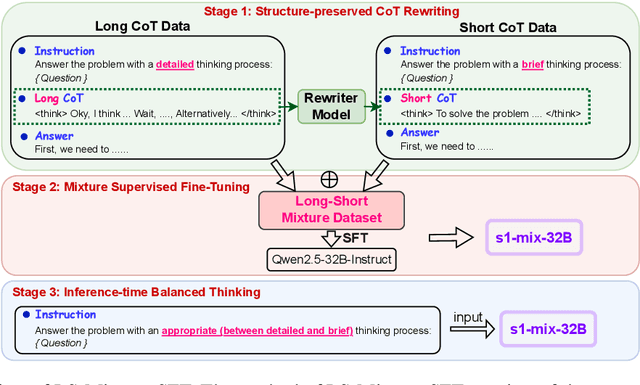
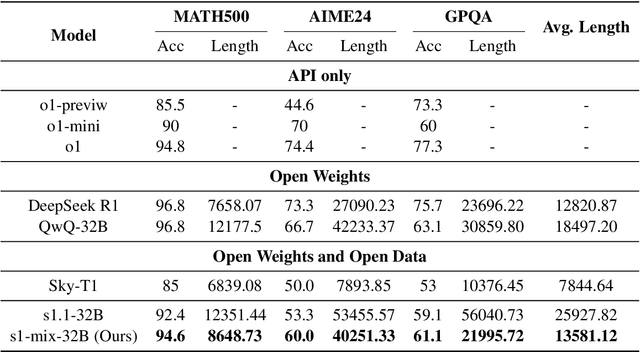
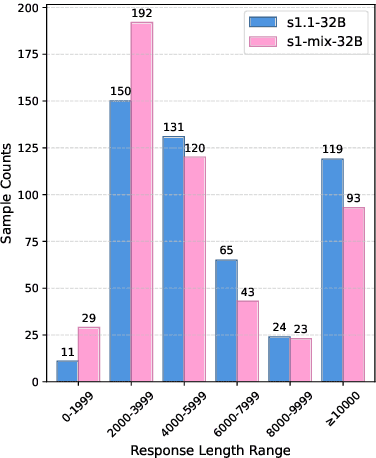
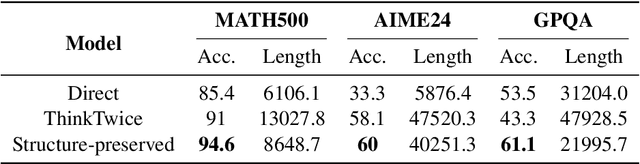
Recent advances in large language models have demonstrated that Supervised Fine-Tuning (SFT) with Chain-of-Thought (CoT) reasoning data distilled from large reasoning models (e.g., DeepSeek R1) can effectively transfer reasoning capabilities to non-reasoning models. However, models fine-tuned with this approach inherit the "overthinking" problem from teacher models, producing verbose and redundant reasoning chains during inference. To address this challenge, we propose \textbf{L}ong-\textbf{S}hort Chain-of-Thought \textbf{Mixture} \textbf{S}upervised \textbf{F}ine-\textbf{T}uning (\textbf{LS-Mixture SFT}), which combines long CoT reasoning dataset with their short counterparts obtained through structure-preserved rewriting. Our experiments demonstrate that models trained using the LS-Mixture SFT method, compared to those trained with direct SFT, achieved an average accuracy improvement of 2.3\% across various benchmarks while substantially reducing model response length by approximately 47.61\%. This work offers an approach to endow non-reasoning models with reasoning capabilities through supervised fine-tuning while avoiding the inherent overthinking problems inherited from teacher models, thereby enabling efficient reasoning in the fine-tuned models.
Deep Sparse Latent Feature Models for Knowledge Graph Completion
Nov 24, 2024
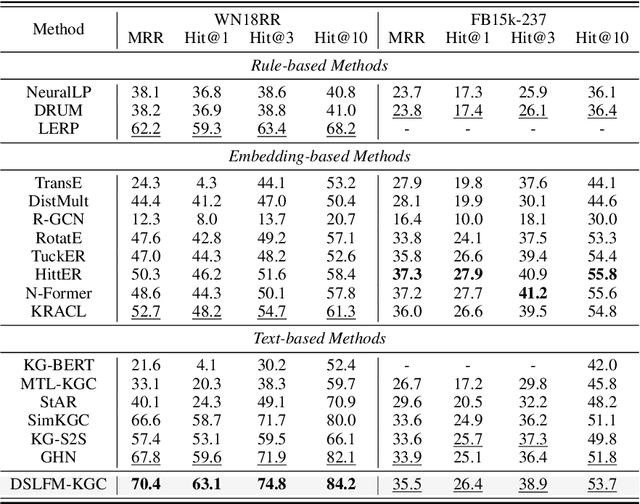

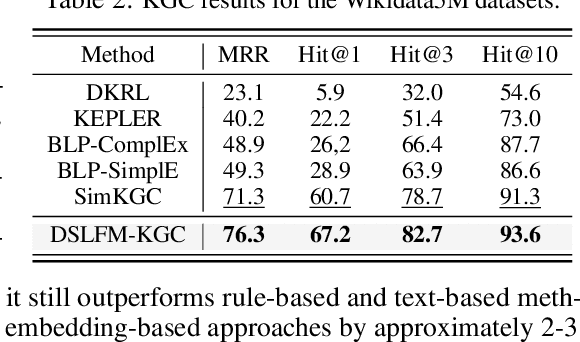
Recent progress in knowledge graph completion (KGC) has focused on text-based approaches to address the challenges of large-scale knowledge graphs (KGs). Despite their achievements, these methods often overlook the intricate interconnections between entities, a key aspect of the underlying topological structure of a KG. Stochastic blockmodels (SBMs), particularly the latent feature relational model (LFRM), offer robust probabilistic frameworks that can dynamically capture latent community structures and enhance link prediction. In this paper, we introduce a novel framework of sparse latent feature models for KGC, optimized through a deep variational autoencoder (VAE). Our approach not only effectively completes missing triples but also provides clear interpretability of the latent structures, leveraging textual information. Comprehensive experiments on the WN18RR, FB15k-237, and Wikidata5M datasets show that our method significantly improves performance by revealing latent communities and producing interpretable representations.
LiPar: A Lightweight Parallel Learning Model for Practical In-Vehicle Network Intrusion Detection
Nov 14, 2023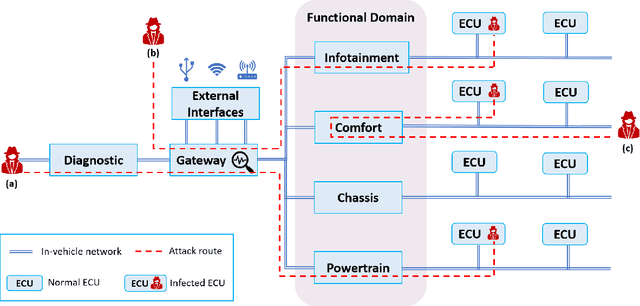
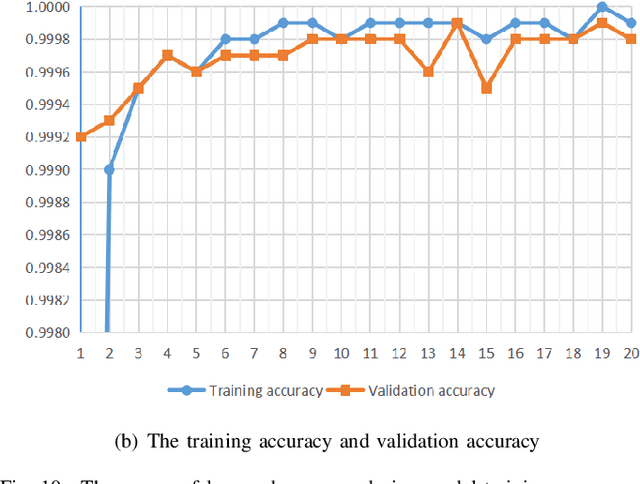
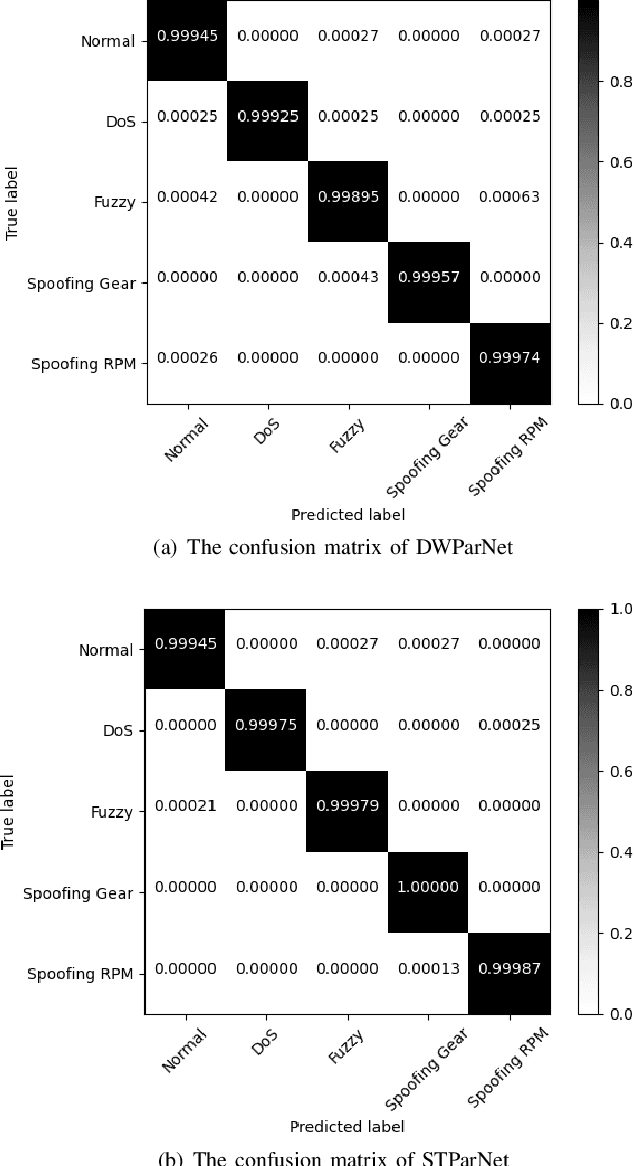
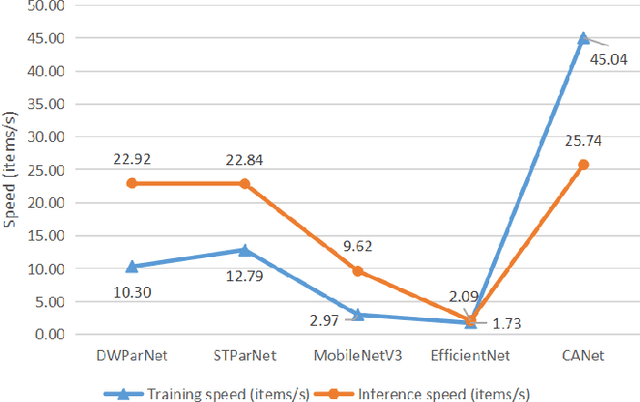
With the development of intelligent transportation systems, vehicles are exposed to a complex network environment. As the main network of in-vehicle networks, the controller area network (CAN) has many potential security hazards, resulting in higher requirements for intrusion detection systems to ensure safety. Among intrusion detection technologies, methods based on deep learning work best without prior expert knowledge. However, they all have a large model size and rely on cloud computing, and are therefore not suitable to be installed on the in-vehicle network. Therefore, we propose a lightweight parallel neural network structure, LiPar, to allocate task loads to multiple electronic control units (ECU). The LiPar model consists of multi-dimensional branch convolution networks, spatial and temporal feature fusion learning, and a resource adaptation algorithm. Through experiments, we prove that LiPar has great detection performance, running efficiency, and lightweight model size, which can be well adapted to the in-vehicle environment practically and protect the in-vehicle CAN bus security.
Effective In-vehicle Intrusion Detection via Multi-view Statistical Graph Learning on CAN Messages
Nov 13, 2023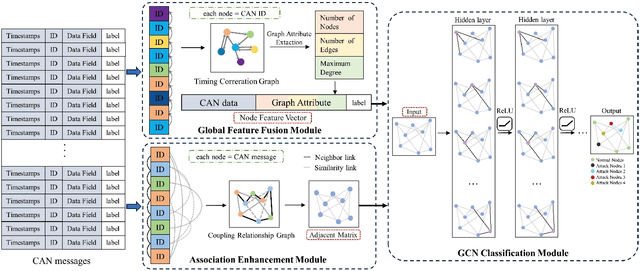
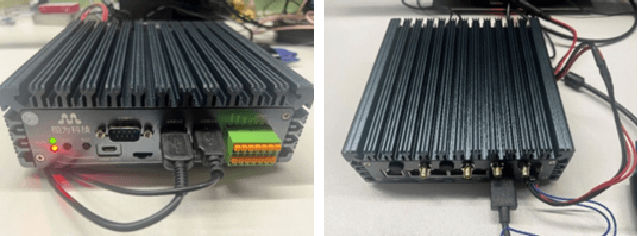
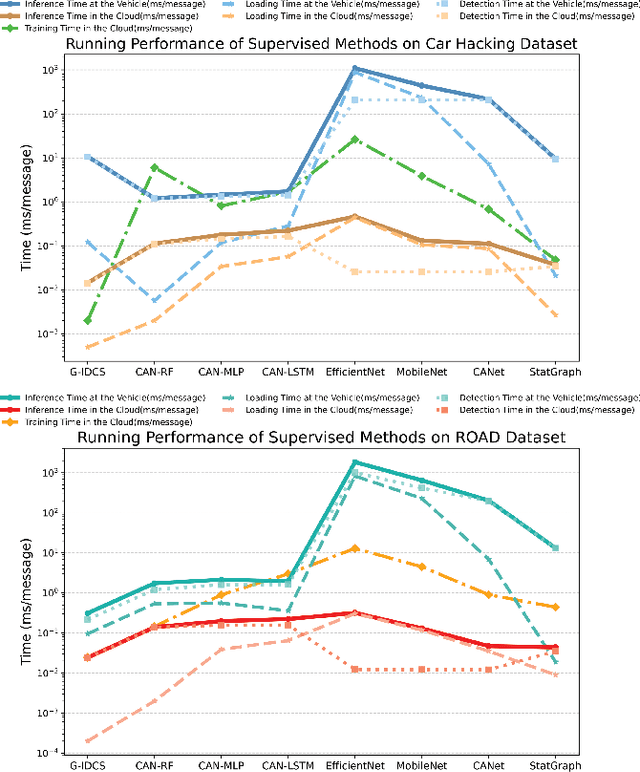
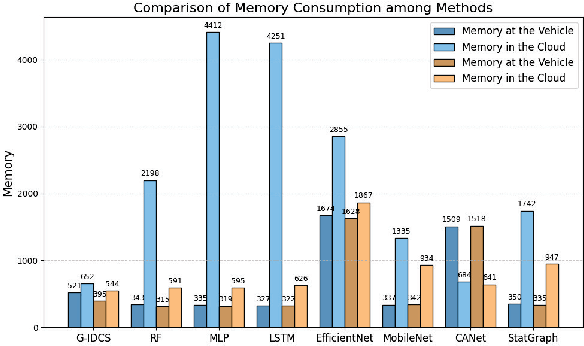
As an important component of internet of vehicles (IoV), intelligent connected vehicles (ICVs) have to communicate with external networks frequently. In this case, the resource-constrained in-vehicle network (IVN) is facing a wide variety of complex and changing external cyber-attacks, especially the masquerade attack with high difficulty of detection while serious damaging effects that few counter measures can identify successfully. Moreover, only coarse-grained recognition can be achieved in current mainstream intrusion detection mechanisms, i.e., whether a whole data flow observation window contains attack labels rather than fine-grained recognition on every single data item within this window. In this paper, we propose StatGraph: an Effective Multi-view Statistical Graph Learning Intrusion Detection to implement the fine-grained intrusion detection. Specifically, StatGraph generates two statistical graphs, timing correlation graph (TCG) and coupling relationship graph (CRG), based on data streams. In given message observation windows, edge attributes in TCGs represent temporal correlation between different message IDs, while edge attributes in CRGs denote the neighbour relationship and contextual similarity. Besides, a lightweight shallow layered GCN network is trained based graph property of TCGs and CRGs, which can learn the universal laws of various patterns more effectively and further enhance the performance of detection. To address the problem of insufficient attack types in previous intrusion detection, we select two real in-vehicle CAN datasets that cover four new attacks never investigated before. Experimental result shows StatGraph improves both detection granularity and detection performance over state-of-the-art intrusion detection methods.
KERMIT: Knowledge Graph Completion of Enhanced Relation Modeling with Inverse Transformation
Sep 26, 2023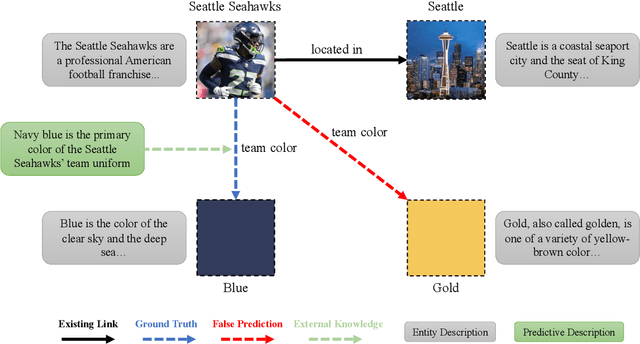

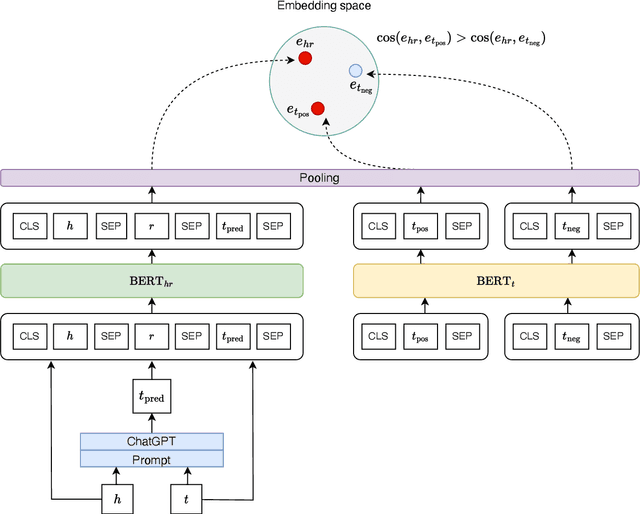

Knowledge graph completion is a task that revolves around filling in missing triples based on the information available in a knowledge graph. Among the current studies, text-based methods complete the task by utilizing textual descriptions of triples. However, this modeling approach may encounter limitations, particularly when the description fails to accurately and adequately express the intended meaning. To overcome these challenges, we propose the augmentation of data through two additional mechanisms. Firstly, we employ ChatGPT as an external knowledge base to generate coherent descriptions to bridge the semantic gap between the queries and answers. Secondly, we leverage inverse relations to create a symmetric graph, thereby creating extra labeling and providing supplementary information for link prediction. This approach offers additional insights into the relationships between entities. Through these efforts, we have observed significant improvements in knowledge graph completion, as these mechanisms enhance the richness and diversity of the available data, leading to more accurate results.